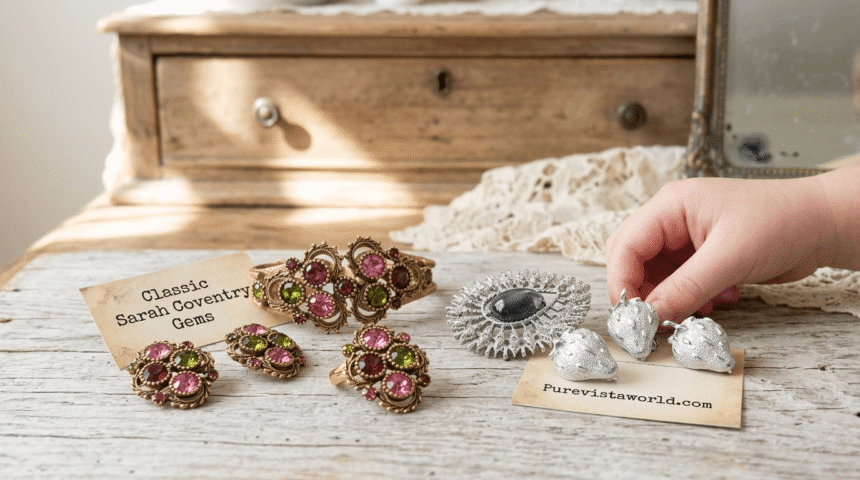
Sarah Coventry jewelry refers to a line of American costume jewelry that became widely known through home parties from the late 1940s into the early 1980s. Named after a real family member rather than a designer, the brand produced affordable, fashion-forward pieces in gold- and silver-tone metals set with rhinestones, cabochons, enamel, and faux gemstones. Today it appeals mainly to collectors of mid-century costume jewelry who value its abundance, recognizable marks, and period designs.
This article covers the company’s origins and business model, typical materials and styles, how to identify and roughly date pieces, current collecting realities, and answers to common questions. Information draws from established company timelines, collector references, and documented production practices.
Origins and Business Model
Sarah Coventry was launched in 1949 in Newark, New York, by the Stuart family through the C.H. Stuart Company. Lyman K. Stuart (or close family members, depending on the account) established it alongside the related Emmons Jewelry line. The name honored Lyman’s granddaughter, Sarah Coventry Beale (later Gaffin), born that same year. She was not a designer; the brand simply carried her name.
Unlike many jewelry houses of the era that relied on department-store counters or celebrity endorsements, Sarah Coventry used a direct-selling “party plan.” Independent representatives hosted gatherings in private homes where women could try on pieces, place orders, and earn hostess gifts or discounts. This approach suited post-war suburban life and grew rapidly. By the 1960s and early 1970s the company was described as one of the largest direct sellers of jewelry, with high daily sales volumes and strong name recognition.
The company did not manufacture its own jewelry. Designs were purchased from freelancers or commissioned, then produced by outside firms, many in Rhode Island. S&M Enameling worked with the brand for two decades; some pieces have also been linked to makers associated with the Juliana line (DeLizza & Elster). Materials included plated base metals, rhinestones (including aurora borealis finishes), cabochons, enamel, plastic, and simulated stones in a wide range of colors.
A brief higher-end experiment, Lord & Lady Coventry, offered gold-filled and sterling pieces with semi-precious stones in the mid-1960s through the late 1970s. The core line remained costume jewelry aimed at everyday wear and gifts.
Changing social patterns reduced interest in home parties by the early 1980s. The original company filed for bankruptcy around 1981–1984. The trademark later passed through several owners, including a period of Home Shopping Network sales and short-lived revival attempts in the 2000s. By 2009 the brand had largely ceased active production under that name. Vintage pieces from the family-controlled era (roughly 1949–early 1980s) remain the primary focus for collectors.
Typical Styles and Characteristics
Sarah Coventry designs tracked mid-century fashion trends while remaining accessible. Early pieces often featured refined floral motifs and aurora borealis rhinestones. The 1960s brought larger geometric and mod shapes, colorful stone combinations, and bold pendants. The 1970s favored textured metals, earth tones, chunky forms, and figural designs such as leaves, fruits, or animals.
Common categories include:
- Brooches and pins (floral, figural, rhinestone clusters)
- Necklaces and pendants (chokers, longer chains, multi-strand)
- Earrings (mostly clip-on in earlier decades; later pierced options)
- Bracelets (bangles, link styles, cuffs)
- Occasional rings and matching sets (parures)
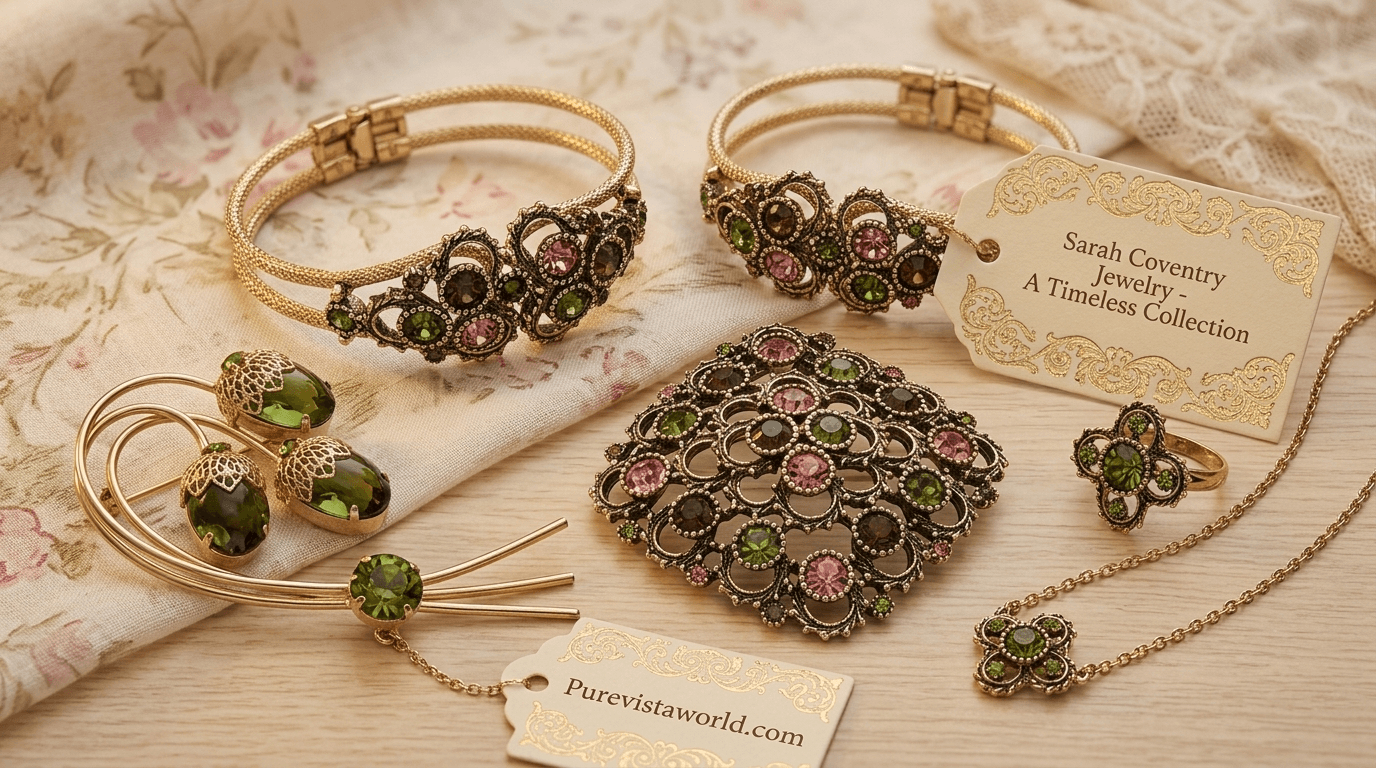
Popular lines among collectors include colorful rhinestone groups such as Blue Lagoon (often cited as a hostess exclusive with aurora borealis and blue/purple tones), Celebrity, Midnight Magic, and various floral or mosaic designs. Pieces frequently came in coordinated sets and original branded packaging or hang tags, which add appeal when present.
Construction is typical of good mid-century costume jewelry: plated metal, prong or glue-set stones, and solid but not heirloom-grade hardware. Wear on high-contact areas (clip backs, pin stems, plating edges) is common and expected.
Identifying and Dating Sarah Coventry Pieces
Most pieces from the mid-1950s onward carry a mark. Early production (roughly through 1955) was sometimes unsigned. Later marks vary and include:
- SAC or SaC
- SC
- Sarah Cov or ©SARAHCOV
- Sarah or ©SARAH
- Coventry or ©COVENTRY
- Full “Sarah Coventry” in various lettering styles
Marks usually appear stamped on the reverse of brooches, earring clips, or clasps. Hang tags also occurred: a double-sided hand-mirror style (often linked to the 1960s) and a diamond-shaped tag (more common in the 1970s). Special lines sometimes carried additional wording such as “Lord Coventry” or references to copper or sterling.
Dating relies more on style and construction cues than on marks alone, since the same mark styles overlapped years:
- 1950s: lighter florals, refined gold-tone, aurora borealis stones, clip earrings
- 1960s: larger stones, geometric or colorful compositions, silver-tone options
- 1970s: chunkier forms, textured surfaces, earth tones or bold pendants
- Post-bankruptcy or revival pieces tend to use simpler “SC” or full-name marks and often show different quality or construction.
Original catalogs, if available, provide the most precise dating. Condition, completeness of sets, and presence of original boxes or tags influence desirability more than exact year for most buyers.
Collecting Practicalities and Value Considerations
Because so many pieces were produced and sold, Sarah Coventry jewelry remains widely available at estate sales, antique shops, flea markets, and online marketplaces. Most individual items or simple pairs sell in the lower tens of dollars; many basic examples fall in the $10–50 range depending on design, condition, and color. Complete matching sets, hostess exclusives, and vivid rhinestone examples from the 1960s–1970s can command higher prices, sometimes into the low hundreds for especially desirable or scarce combinations. Original packaging adds modest value.
Value is driven by visual appeal, condition of plating and stones, rarity of the specific design or colorway, and completeness rather than intrinsic metal content. The jewelry is costume quality; plating wear and loose stones are common. Collectors generally prefer pieces from the original family era over later revivals.
Practical tips for buyers and owners:
- Examine marks carefully in good light and compare lettering style.
- Check stone settings and clip mechanisms for security.
- Clean gently; avoid harsh chemicals that can damage plating or adhesives.
- Store separately to prevent scratching.
- When buying online, request clear photos of marks and any defects.
The brand’s accessibility makes it a good entry point for costume-jewelry collectors. It also pairs well with other mid-century American makers for themed displays.
Frequently Asked Questions
Was there a real Sarah Coventry?
Yes. Sarah Coventry Beale (later Gaffin) was the granddaughter of Lyman K. Stuart. She was born in 1949 and died in 2020. She was not involved in designing the jewelry.
Is Sarah Coventry jewelry still made?
Active production under the original company model ended with the bankruptcies of the early 1980s. Later attempts to revive the name did not restore the earlier scale or longevity. The pieces most sought by collectors are vintage examples from roughly 1949 to the early 1980s.
How can I tell if a piece is authentic?
Look for consistent period marks, construction typical of mid-century costume jewelry, and style that matches documented catalogs or known lines. Unsigned early pieces exist but are less common after the mid-1950s.
Are complete sets more valuable?
Yes. Matching necklace, bracelet, and earring combinations, especially in popular colorways or hostess designs, generally sell for more than individual components.
Sarah Coventry jewelry captures a specific moment in American retail and fashion history—the rise of home-party selling and the democratization of stylish, affordable accessories. For collectors it offers an approachable, recognizable body of work that rewards attention to marks, condition, and design details without requiring large budgets. Whether you inherit a box of pieces or seek them out deliberately, understanding the brand’s background and typical traits helps you appreciate and evaluate them accurately.
Conclusion
Sarah Coventry jewelry remains a distinctive chapter in mid-century American costume jewelry. Born from a direct-selling model that brought fashion accessories into living rooms across the country, the brand produced a wide range of accessible, trend-aware pieces that many women of the 1950s through early 1980s wore and collected.
Today its appeal rests on clear strengths: recognizable marks that aid identification, designs that reflect the styles of their decades, and an abundance of available examples that keep most pieces affordable. Collectors value complete sets, hostess exclusives, and colorful rhinestone work from the 1960s and 1970s most highly, while everyday floral, figural, and pendant designs offer an easy entry point for new enthusiasts.
Because production was large-scale and the company eventually closed, the jewelry is neither rare in the absolute sense nor intrinsically precious. Its interest lies in historical context, visual charm, and the practical enjoyment of wearing or displaying well-made costume pieces from a bygone retail era. With basic knowledge of marks, construction, and typical styles, anyone can confidently evaluate, care for, and appreciate Sarah Coventry jewelry without needing extensive expertise or a large budget.