What Does IDM Mean in Text?
Quick Definition of IDM
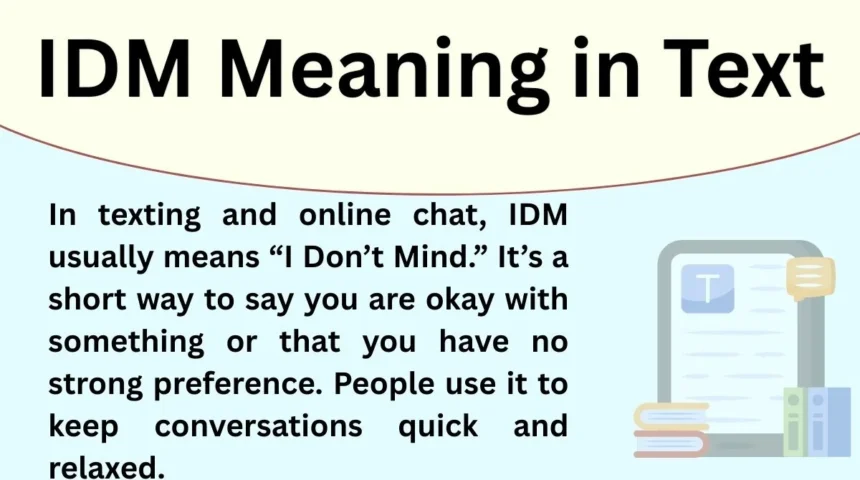
In texting and online communication, IDM is a commonly used slang term that stands for “I Don’t Mind.” It is used to express flexibility, agreement, or indifference toward a suggestion or situation.
- What Does IDM Mean in Text?
- What Does IDM Stand for in Slang?
- When and How Is IDM Used in Texting?
- Everyday Chat Usage
- Casual vs Formal Conversations
- Social Media Usage (WhatsApp, Instagram, TikTok, Snapchat)
- Examples of IDM in Text Messages
- Why Do People Use IDM in Texting?
- Emotional and Contextual Meaning of IDM
- How to Reply When Someone Says IDM
- Common Misunderstandings of IDM
- Variations, Alternatives & Similar Slang to IDM
- IDM Meaning Across Different Platforms
- Is IDM Still Popular? Trends in 2026
- IDM in Different Contexts and Fields
- FAQs
- What does IDM mean in a text?
- Does IDM mean “I don’t mind”?
- What does it mean if a girl says IDM?
- Is IDM rude or polite?
- What does IDM mean in Gen Z slang?
- Conclusion
- Also Read
For example, if someone asks, “Do you want to go out or stay home?”, replying with “IDM” means you are okay with either option.
In simple terms:
IDM = I’m okay with it / I have no strong preference
Full Form of IDM in Chat
The full form of IDM in chat is:
I Don’t Mind
This phrase is widely used in:
- Text messages
- Social media chats
- Online conversations
It reflects a relaxed and easygoing attitude, making it popular in casual communication.
What Does IDM Stand for in Slang?
Common Meaning (“I Don’t Mind”)
The most common and widely accepted meaning of IDM in slang is:
I Don’t Mind
It is used when:
- You agree with someone
- You have no preference
- You’re open to suggestions
Example:
Friend: “Should we watch a movie or a series?”
You: “IDM”
Other Possible Meanings of IDM
Although “I Don’t Mind” is the primary meaning, IDM can have different meanings depending on context, such as:
- It Doesn’t Matter (less common variation)
- Integrated Device Manufacturer (technical/business context)
- Intelligent Dance Music (music genre)
However, in texting and social media, “I Don’t Mind” is the correct meaning in most cases.
When and How Is IDM Used in Texting?
Everyday Chat Usage
IDM is mostly used in casual conversations where decisions are flexible.
Common situations:
- Making plans
- Choosing options
- Responding casually
Example:
“Do you want pizza or burgers?” → “IDM”
Casual vs Formal Conversations
- Casual chats: IDM is perfectly acceptable
- Formal communication: Avoid using IDM (use full sentences instead)
Casual:
“IDM, you can decide.”
Formal:
“I don’t have a preference.”
Tip: IDM is best used with friends, not in professional emails.
Social Media Usage (WhatsApp, Instagram, TikTok, Snapchat)
IDM is widely used across platforms like:
- WhatsApp chats
- Instagram DMs
- TikTok comments
- Snapchat conversations
It fits perfectly in fast, short-form communication where users prefer quick replies.
Examples of IDM in Text Messages
Simple Chat Examples
- “Where should we go?” → “IDM”
- “Tea or coffee?” → “IDM”
- “You pick the movie.” → “IDM”
Real-Life Conversation Scenarios
Scenario 1:
Friend: “Let’s meet at 6 or 7?”
You: “IDM, whatever works for you.”
Scenario 2:
Colleague: “Should we do this today or tomorrow?”
You: “IDM, your call.”
Funny and Casual Examples
- “Should I annoy you or let you rest?” → “IDM ”
- “Pizza or diet?” → “IDM… pizza obviously ”
These examples show how IDM keeps conversations light and flexible.
Why Do People Use IDM in Texting?
Convenience and Speed
One of the biggest reasons people use IDM is speed.
Instead of typing:
“I don’t mind, you can choose”
They simply write:
“IDM”
Saves time
Keeps conversation quick
Expressing Flexibility or Agreement
IDM is often used to show:
- Openness
- Agreement
- Lack of strong preference
It makes you sound easygoing and cooperative in conversations.
Modern Slang Trends
With the rise of texting culture and Gen Z communication, short forms like IDM have become very popular.
People prefer:
- Short replies
- Quick expressions
- Informal tone
That’s why IDM continues to trend in modern digital communication (2026 and beyond).
Emotional and Contextual Meaning of IDM
Does IDM Mean “I Don’t Care”?
This is one of the most common questions users have. While IDM primarily means “I don’t mind,” it can sometimes feel like “I don’t care” depending on context.
Key difference:
- IDM (I don’t mind) = Flexible, okay with options
- IDC (I don’t care) = Indifferent or uninterested
Example:
- “We can go anywhere, IDM” → Positive/flexible
- “IDM, do whatever” → Might sound careless
So, IDM does not directly mean “I don’t care,” but tone can make it feel that way.
Tone Differences Based on Context
The meaning of IDM changes based on:
- Conversation tone
- Relationship with the person
- Situation
Friendly tone:
“IDM you choose” → Warm and cooperative
Neutral tone:
“IDM” → Simple agreement
Cold tone:
“IDM…” → Could seem uninterested
Always consider context before interpreting IDM.
Positive vs Neutral vs Negative Use
Positive Use:
- Shows flexibility
- Friendly and easygoing
“IDM, I trust your choice!”
Neutral Use:
- No strong opinion
“IDM”
Negative Use (rare):
- May sound dismissive
“IDM, do whatever you want”
The same word can feel very different depending on tone.
How to Reply When Someone Says IDM
Best Replies in Different Situations
When someone says IDM, they are giving you control of the decision.
Good replies:
- “Alright, let’s go with this then.”
- “Okay, I’ll decide ”
- “Cool, I’ll pick something good.”
Polite vs Casual Responses
Polite replies:
- “Thanks, I’ll choose something suitable.”
- “Alright, I’ll make a decision.”
Casual replies:
- “Okay, I got this ”
- “Cool, I’ll pick!”
Match your reply to the tone of the conversation.
What to Avoid When Responding
Don’t overthink their message
Don’t assume they don’t care
Don’t respond aggressively
Example to avoid:
“Why don’t you care?”
Instead, keep it simple and positive.
Common Misunderstandings of IDM
Confusion with “I Don’t Matter”
Some people mistakenly think IDM means:
“I don’t matter”
This is incorrect in texting slang.
Correct meaning:
“I don’t mind”
Misinterpreting Tone
Because IDM is short, people often misread its tone.
Without emojis or context:
- It can seem dry
- Or even rude
Tip: Add emojis for clarity
“IDM ”
Overuse in Conversations
Using IDM too often can:
- Make you seem uninterested
- Show lack of opinion
Balance it with actual input when needed.
Variations, Alternatives & Similar Slang to IDM
Similar Terms (IDC, IDK, NVM)
Here are common alternatives:
- IDC = I Don’t Care
- IDK = I Don’t Know
- NVM = Never Mind
Each has a slightly different meaning.
Differences Between IDM and IDC
This is very important:
| Term | Meaning | Tone |
|---|---|---|
| IDM | I don’t mind | Flexible |
| IDC | I don’t care | Indifferent |
Using IDC instead of IDM can sound rude.
When to Use Alternatives
Use alternatives based on situation:
- Use IDM → When you’re okay with options
- Use IDK → When unsure
- Use NVM → When canceling something
IDM Meaning Across Different Platforms
WhatsApp & Messenger
- Most common usage
- Used in daily conversations
Quick and casual replies
Instagram & TikTok
- Used in DMs and comments
- Often paired with emojis
Example: “IDM ”
Snapchat & Online Gaming Chats
- Used in fast-paced chats
- Helps keep communication quick
Popular among gamers and Gen Z users
Is IDM Still Popular? Trends in 2026
Gen Z Usage
Gen Z heavily uses short slang like IDM.
They prefer:
- Fast replies
- Short forms
- Casual tone
Popularity in Online Culture
IDM remains popular because:
- It’s simple
- Easy to understand
- Widely accepted
Still trending across social platforms.
Future of Texting Slang
Slang keeps evolving, but:
Simple abbreviations like IDM are likely to stay
Because they:
- Save time
- Fit digital communication style
IDM in Different Contexts and Fields
General Chat Meaning
In everyday texting:
IDM = I don’t mind
Used in:
- Personal chats
- Social media
- Casual discussions
Other Industry Meanings (Music, Tech, etc.)
Outside texting, IDM can mean:
- Music: Intelligent Dance Music
- Tech: Integrated Device Manufacturer
Context is key to understanding meaning.
FAQs
What does IDM mean in a text?
IDM means “I don’t mind.” It shows flexibility or agreement.
Does IDM mean “I don’t mind”?
Yes, that is the most common and correct meaning in texting.
What does it mean if a girl says IDM?
It simply means she is okay with your choice and has no strong preference.
Is IDM rude or polite?
It is generally polite and neutral, but tone can change meaning.
What does IDM mean in Gen Z slang?
In Gen Z slang, IDM still means “I don’t mind,” used in casual chats.
Conclusion
IDM is a simple yet powerful texting slang that means “I don’t mind.” It is widely used to express flexibility, agreement, and a relaxed attitude in conversations.
When and How to Use IDM Correctly
Use IDM when:
- You’re okay with any option
- You want to sound easygoing
- You don’t have a strong preference
Avoid using it:
- In formal communication
- When clarity is needed